Welcome to the RDEC FAQ (Frequently Asked Questions) page
Administrative | Program Use | Technical | Ask a question
- 1. Am I allowed to make and share copies of the RDEC program?
- Yes, you may make and share copies of the RDEC program provided that you read and agree to comply with the Terms and Conditions of Use of the RDEC program.
- 2. Can I incorporate the RDEC program within other programs that I may write?
- No, you may not. The manner in which the RDEC program may be used is strictly limited by the Terms and Conditions of Use of the RDEC program to which you must agree before using the RDEC program in any way or for any purpose.
- 3. What are the current versions of the RDEC program and User's Manual?
- The current version of the RDEC program is 1.0.82, and the current version of the RDEC User's Manual is Revision B: 2011-11-22.
- 1. What kinds of revolving doors can the RDEC program handle?
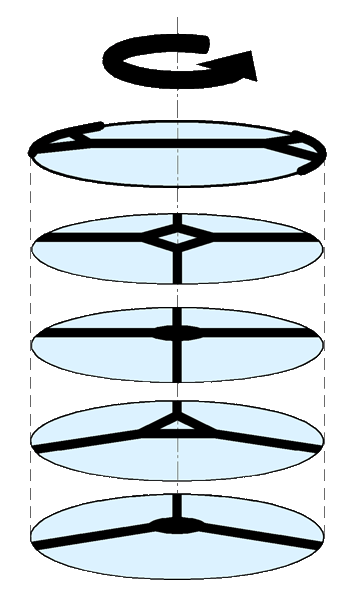
- RDEC can handle properly five types of revolving doors:
Moreover, RDEC can handle additional door components for any of these types of doors such as a co-rotating ceiling, showcase floors (2-wing doors only), and other objects of an arbitraty nature rotating with the door such as structural beams and control devices and equipment.- 2-wing doors with showcases.
- 3-wing doors with and without a core.
- 4-wing doors with and without a core.
- 2. When I use RDEC with a 3-wing or 4-wing door with a core, why am I not asked for the width of the
core panels?
- Because the overall diameter of the door, whether it is a 3-wing or a 4-wing door, and the width of the radially directed panels, which you are asked to provide, are sufficient for RDEC to determine, along with the assumption that the core is either an equilateral triangle (3-wing door) or a square (4-wing door), the width of the core panels. Consequently, it is not necessary for you to enter the core panel width.
- 1. I am not able to run RDEC under the Microsoft Windows 7 operating system. What is wrong?
- Certain system support files required by RDEC were, unfortunately, not carried forward by Microsoft into the Windows 7 operating system. If you downloaded your copy of RDEC prior to June 15, 2012, the required support files were not included in the download, with the result that RDEC will not run under Windows 7. To remedy this problem so that RDEC will run under Windows 7, as well as prior versions of Windows, we have as of June 15, 2012, modified the RDEC download to include the required system support files. Therefore, to run RDEC under Windows 7, simply re-install RDEC following the instructions and link provided near the bottom of the RDEC Home Page.
- 2. Does the kinetic energy of a rotating door depend upon location within the door?
- No, it does not. The rotational kinetic energy of the door is a property of the entire door in much the same way that the weight of an object is a property of the entire object. Thus, whether in close to the axis of rotation or out near the periphery, for a given rotation rate the kinetic energy of the door is the same at either location and at all intermediate locations.
- 3. Does the spacing of the wings of the door around the axis of rotation affect the kinetic energy?
- No, it does not. As long as all components of the door rotate as a rigid unit with the door and their individual centers-of-mass remain at the same radial distance from the axis of rotation, the kinetic energy of the door at a given rotation rate will remain unchanged.
- 4. Upon what are the kinetic energy equations in RDEC based? Where did they come from?
- They are based on the laws of classical physics, known essentially from the time of Isaac Newton, and were derived for the RDEC program by Warren F. Davis, Ph.D. A document presenting the derivations of all equations used by the RDEC program can be downloaded here.
RDEC Home Page